

Decades for Dissent
The injustice of the Prairieland sentences

Imagine going to a protest. You’re upset about an injustice and hoping to make your voice heard. But while you’re at the protest, something unexpected happens. One of the other protesters commits a violent crime. Would you expect to be incarcerated as a result, simply for being at the same protest? Would you expect to be incarcerated for decades? How about for half a century? What about for 70 years?
If you answered “no,” then you may find recent news from Texas concerning. On Tuesday, June 23, 2026, eight activists were sentenced to decades in prison stemming from a noise demonstration held outside the Prairieland Detention Center on July 4, 2025, in Alvarado, Texas. As activist and content creator Ariana Jasmine explains:
The case stems from a Fourth of July protest at the Prairieland Detention Center in Alvarado, Texas, where activists gathered late at night for a noise demonstration meant to show solidarity with people detained inside. Prosecutors said some demonstrators vandalized property, including vehicles, a guard shack, tires, and a security camera. When law enforcement arrived, one activist, Benjamin Song, fired an AR-15 from nearby woods and struck an officer in the shoulder; the officer survived.
Song claims that he fired his weapon in an effort to defend others. However, Judge Mark Pittman prohibited any self-defense arguments from being presented at trial.
Shooting a gun at a police officer does not end well, even if no one dies. It’s not surprising that Benjamin Song was convicted of attempted murder and sentenced to 100 years in prison.
But the charges, convictions, and sentences faced by other activists associated with the protest are surprising. More importantly, they should be deeply troubling for everyone who cares about free speech and the right to dissent.
Each of Song’s codefendants has been sentenced to decades in prison. Most received 50 year sentences, although one received 30 years, while another got a whopping 70 years. All this despite the fact that only Song fired a weapon, and one of the defendants was not even present at the Prairieland noise demonstration.
Weaponizing the War on Terror
Prosecutors claimed that these activists were members of a “North Texas Antifa Cell.” This designation is part of the Trump administration’s ongoing efforts to define “antifa,” a term that is short for “anti-fascist,” as a serious domestic terror threat. In September, 2025, President Donald Trump issued an executive order that aimed to “designate Antifa as a ‘domestic terrorist organization,’” despite the fact that “antifa” refers to a decentralized social movement, not an organization. Later that same month, Trump issued a National Security Presidential Memorandum (NSPM-7) that called for a “national strategy” to combat this purported domestic terror threat.
In a piece about NSPM-7, Hina Shamsi of the American Civil Liberties Union (ACLU) warns that:
Perhaps the most chilling rhetorical move the president makes is to use vague, broad labels that, even if true—and there’s good reason to question the truth of virtually all of the memo’s assertions—encompass First Amendment-protected beliefs unconnected to any actual criminal conduct. These labels include: “Anti-Americanism, anti-capitalism, and anti-Christianity,” “support for the overthrow of” the federal government, “extremism on migration, race, and gender,” and opposition to “traditional American views on family, religion, and morality.” The president even bizarrely imagines that “support for law enforcement and border control” are “foundational American principles” that his political opponents paint as “fascist” to encourage violence. No wonder many in civil society see NSPM-7’s rhetoric as a threat to human rights, civil liberties, and democracy-building work.
The Prairieland case illustrates how this threat works in practice.
Protesters Zachary Evetts, Autumn Hill, Savanna Batten, Elizabeth Soto, Meagan Morris, and Maricela Rueda were all convicted of “providing material support to terrorists.”
The prosecution tried to show that some of them were involved, alongside Song, in attempted murder. However, as The Guardian reports, “Evetts, Hill, Morris and Rueda were acquitted on attempted murder and firearms charges.”
The prosecution could not show that any protesters other than Song attempted to harm officers. To convict the other defendants of “material support for terrorists,” they highlighted various forms of circumstantial evidence.
For instance, prosecutors emphasized what the defendants were wearing. As Matt Sledge reported at The Intercept:
In a significant victory for the government, jurors convicted eight defendants on material support for terrorism charges for wearing black clothes to the late-night demonstration. That use of “black bloc” clothing was an antifa tactic that assisted in the shooting of the officer, prosecutors said during their closing arguments.
It’s true that activists sometimes wear black or otherwise non-descript clothing to be less identifiable at protests. This is not proof of any criminal intent. It may instead reflect that they fear reprisal and repression for participating in protests.
Similar fear of repression leads many activists to adopt security practices aimed at warding off surveillance. For example, many activists use the encrypted messaging platform Signal to chat with each other. In a world of mass surveillance, using an encrypted messaging platform makes sense, even if you’re doing nothing illegal.
But digital security practices and fear of surveillance were used against the defendants. Prosecutors framed the defendants’ use of encrypted chats as evidence of nefarious intent. For instance, in the superseding indictment, prosecutors asserted:
To hide their involvement in illegal conduct, the Antifa Cell emphasized and practiced “operational security” or “opsec” in their communications. For example, members used an encrypted messaging app to coordinate with each other. This app allowed for group chats and had auto-delete and delete-after-a-defined-time functions, which caused communications among the Antifa Cell to be permanently deleted.
These types of opsec practices and use of Signal chats are widely discussed and recommended among activists. See this guide from Micah Lee for one example. The plain truth is that activists have good reason to fear retaliation and surveillance, both by the state and by non-state actors that oppose them. Choosing to use secure communications is not evidence of illegal or nefarious intent.
A press release from the U.S. Department of Justice (DOJ) asserts that “evidence obtained on phone locations supported that those who participated in the attack all turned off their phones or placed them in Faraday bags to prevent tracking.” The DOJ strongly implies that this is evidence of nefarious, criminal intent.
However, many protestors are concerned about surveillance. Civil liberties advocates and privacy experts, such as Harlo Holmes of the Freedom of the Press Foundation, recommend leaving phones at home during protests, or even using Faraday bags to prevent tracking.
As part of the war on terror, the government has drastically expanded its surveillance activities. Protesters understandably take precautions to reduce their vulnerability to this surveillance. Yet for doing so, they’ve been branded terrorists, convicted of “material support” for terrorism, and sentenced to decades in prison.
The government also emphasized that the defendants brought first aid kits to Prairieland. As the DOJ’s recent press release put it, “the defendants brought…eleven military-grade first aid kits with tourniquets and other items to treat gunshot wounds” to Prairieland.
Bringing first aid supplies to a protest is normal and prudent. Even peaceful protests can be dangerous. Protesters may face violence, whether from law enforcement, counter-protesters, or other people. Moreover, accidents happen. In a protest in the hot Texas summer, it’s possible that a demonstrator would suffer from heat exhaustion.
Bringing first aid kits can help address all these possibilities and more. That’s part of why street medics have played a role in protests around the world since at least the days of the civil rights movement. As Tamera Hutchersen, an activist involved in Savanna Batten’s defense team, asked, “If we are to bring a medical kit to a protest, does that mean we are a criminal now?”
Prosecutors sensationalized activities such as protecting privacy and carrying first aid supplies. Through this sensationalism, they managed to insinuate that these ordinary actions reflected a terrorist conspiracy.
As civil libertarians have long warned, the war on terror gives government officials powerful repressive tools. These tools are not just used to counter terrorism as most of us understand it. Instead, they can be used to crack down on political movements.
Zines Are Not a Crime
Perhaps the most disturbing part of the Prairieland case is the prosecution of Daniel Rolando Sanchez Estrada, also known as Des.
Des was not at the noise demonstration at Prairieland. His wife, Maricela Rueda, was present. After her arrest, she allegedly told her mother to contact Des. She also spoke with him on the phone. The prosecution alleges that during these conversations, she conspired with him to conceal or move evidence relevant to the case.
Rueda and Sanchez Estrada were both convicted of “conspiracy to conceal documents.” Sanchez Estrada was also convicted of “corruptly concealing a document or record.” For these crimes, he was sentenced to 30 years in prison.
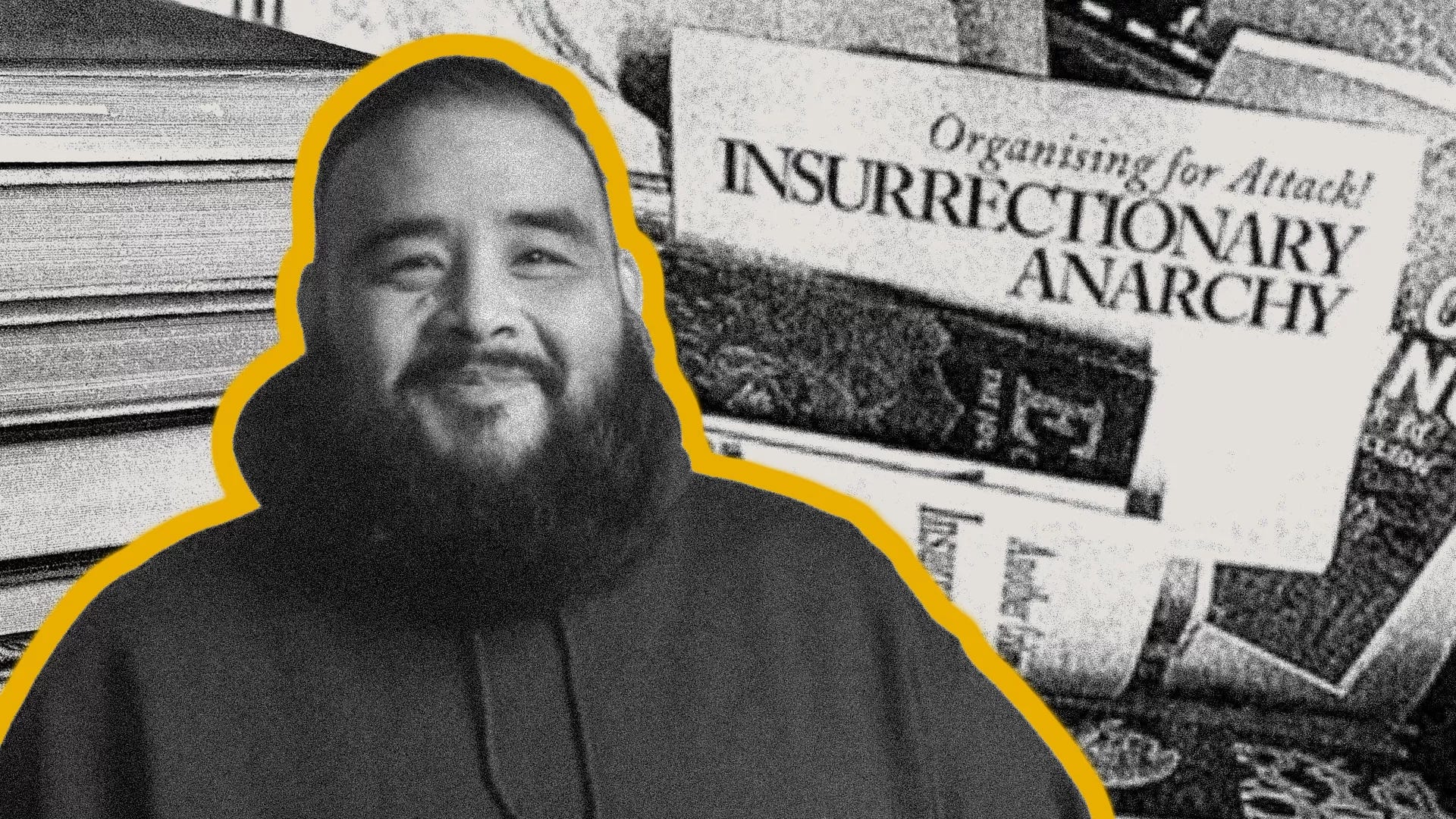
What documents or records did he conceal? The items in question were a box of zines, essentially political pamphlets. These zines are constitutionally protected speech. Anyone can find them online and print them out. People distribute zines just like this at protests, bookfairs, infoshops, independent bookstores, and punk shows, among other places. When they do so, they’re not doing anything criminal. They’re just sharing literature.
To make these political pamphlets sound more nefarious, the prosecution repeatedly describes them as “antifa materials.” For instance, the DOJ’s press release says that Des corruptly concealed documents “by transporting a box containing numerous Antifa materials, such as insurrection planning, anti-law enforcement, anti-government, and anti-immigration enforcement documents and propaganda from Sanchez Estrada’s residence to a location in Denton, Texas.” How can we know which political tracts count as “antifa materials”? How do you know that you’re not in possession of “antifa materials” at this very moment?
The prosecutors claim that Des moved this box of zines “intending to conceal the box’s contents and impair its availability for use in a federal grand jury and federal criminal proceeding.” Des’s public defender disputes this.
But suppose it’s true. The case still raises very serious First Amendment concerns, as Seth Stern of the Freedom of the Press Foundation (FPF) points out:
If prosecutors are correct that Sanchez moved zines because he feared they’d try to use them against his wife, that’s a commentary on prosecutors’ lawlessness, not Sanchez’s. Under the First Amendment, possessing literature cannot be criminal, so what legitimate evidence could he possibly have been concealing? Political zines like those Sanchez possessed are no different from the pro-Revolution pamphlets this country’s founders had in mind when they drafted the First Amendment’s press clause.
Sanchez’s case is the latest example of the Trump administration grasping at any legal straws it can to criminalize disfavored ideologies and writings, from conflating dissent with terrorism to deporting immigrants who report on protests or criticize wars the U.S. bankrolls. Americans should not make the mistake of believing Sanchez’s sentence only threatens immigrants, leftists, or so-called Antifa members — they’re just the low-hanging fruit, not the end game.
If reading political literature may be evidence of a criminal conspiracy, that has a chilling effect on speech, dissent, and free inquiry. The same is true if transporting that literature may be evidence of a conspiracy to corruptly conceal documents.
As Autumn Billings wrote in Reason:
Although free speech advocates sometimes fail to clearly acknowledge that some expressive activities—such as destruction of property, trespassing, or shooting someone, as allegedly happened in this case—are crimes not protected under the First Amendment, they are right to point out the danger inherent in broadly criminalizing protected political dissent—like owning anti-government zines. The more zealously the Trump administration prosecutes dissenting political beliefs as crimes such as domestic terrorism, the more content Americans will deem worthy of concealing, destroying, or shunning for its potential to be used as evidence of criminality—just like in Sanchez-Estrada's case—creating a mass chilling effect.
She warns that “by broadly defining domestic terrorism to include constitutionally protected speech, the Trump administration will be successful in dismantling a lot more than the ‘antifa’ movement, and will dismantle Americans' First Amendment rights instead.”
Des was not the only defendant persecuted over literature. As Lex McMenamin reports at The Guardian, Elizabeth Soto and her husband Ines Soto were prosecuted partially for printing zines. As McMenamin explains, part of the “material support for terrorists” that the Sotos allegedly provided “included owning a ‘printing press’ used to print anarchist zines and being part of a leftist book club.”
The prosecutors wanted to portray zines as inherently threatening. In the superseding indictment, prosecutors wrote that “Ines Soto, Elizabeth Soto, and Batten were part of a group that created and distributed insurrectionary materials called ‘zines.’” That’s quite a way to describe First Amendment protected speech.
An “Attack” or a Noise Demonstration?
Prosecutors repeatedly describe the noise demonstration as an “attack” on the ICE facility. They note that the defendants used fireworks that night. Prosecutors strongly insinuate that these fireworks were used to attack the facility. For example, Ryan Raybould, U.S. Attorney for the Northern District of Texas, said that “explosives launched at a detention facility were a far cry from a peaceful protest or First Amendment expression.” The implication is that this was a malicious and violent firebombing attempt, rather than an unlicensed and unpermitted fireworks display.
But prior to the event, participants consistently discussed it as a noise demonstration. This term suggests that fireworks were used not to attack the detention center, but simply make noise that could be heard by detainees inside. Notably, the noise demonstration was on July 4th, a holiday where fireworks displays are often used to celebrate.
Noise demonstrations outside prisons, jails, and detention centers have a long history. Activists bang pots and pans, use megaphones, or otherwise seek to make a lot of sound that can be heard behind the prison walls. The goal is to tell the incarcerated that they are not alone, that they are not forgotten. For example, after members of the Stop Cop City movement in Atlanta were raided and arrested in December, 2022, their allies held a noise demonstration in solidarity with them outside the Dekalb County Jail.
The use of fireworks by the defendants was meant in the same spirit. The goal was not to use explosives to hurt or harm, but to send a message of care and solidarity to detainees.
Indeed, this goal was explicitly articulated at trial. Notes from the opening statements directly say that demonstrators were “there to bring hope to detainees by using fireworks.” At the demonstration, Maricela Rueda shouted the word “esperanza,” which means “hope,” into a megaphone.
Further support for this motivation can be found in Autumn Hill’s opening statement. She said that after shooting fireworks she “saw prisoners crowding and watching and felt satisfied.” This was a fireworks display on July 4th, for a captive audience that otherwise would not see one.
The goal in shooting fireworks was clear: not to attack anyone, but to spread a message of hope that could be heard and seen by detainees.
Lengthy Sentences
Suppose you’ve found my arguments unconvincing so far. Even if you believe that the convictions are just, an important question remains: Were the sentences proportionate?
Philosophers and legal scholars widely agree that punishments should be proportional to the severity of the crime committed. Do the sentences issued on Tuesday satisfy this principle?
One way to assess this is to compare the sentences to those issued in other cases. Recent reporting from The Guardian suggests the sentences were harsher than normal:
The sentences handed down on Tuesday were unusually long, said Barbara McQuade, a former federal prosecutor who served as the US attorney for the eastern district of Michigan during the Obama administration.
“Most often, judges will sentence defendants for separate counts concurrently. Here, it appears that the judge stacked the sentences for each count consecutively. I would have expected lengthy sentences here, more in the ballpark at 15 to 25 years, but nothing like 50 to 100 years,” she wrote in an email.
When sentences are much longer than those in comparable cases, that suggests the punishment may be disproportionate.
The Substack newsletter In Defense of Movements, which monitors prosecutions of activists, offers another reason to think that the sentences were disproportionate:
Activists who didn’t plan the protest and left when asked still received 50-year terms. The punishment for the protesters exceeds the lengthiest prison sentences given out for the attack on the Capitol on January 6.
Even if you believe that these defendants should be punished, you should question whether the punishment fits the crime.
An Assault on Democracy?
During sentencing, U.S. District Judge Reed O'Connor called the defendants’ actions “an assault on democracy.”
But democracy depends on free speech, the right to dissent, and open inquiry. As Vincent Ostrom writes in his excellent book The Meaning of Democracy and the Vulnerability of Democracies:
If societies of men are to constitute systems of governance from reflection and choice, those societies are required to establish a culture of inquiry rather than a culture of command and control dominated by those engaged in the art of manipulation.
When people are sentenced to decades in prison for the political literature they possess, this threatens to destroy a culture of inquiry and replace it with a culture of command and control.
The Prairieland case is not an isolated incident. For instance, 15 Minnesota residents were recently indicted for protest activities against ICE during Operation Metro Surge. A press release from the Trump administration describes this case as part of their “relentless campaign to eradicate Antifa’s domestic terrorism threat.” But as journalist Elizabeth Weill-Greenberg explains, this “case tests how far prosecutors can go to manufacture a criminal conspiracy based on group chats, social media posts, discussions of protest tactics, and anti-surveillance precautions.”
These cases are blatant crackdowns on dissent. If you cannot dissent from the way you are currently governed, then you cannot meaningfully engage in self-governance. Protests, even contentious ones, have been a crucial part of democratic participation and self-governance throughout America’s 250-year history.
By that standard, the real “assault on democracy” does not come from grassroots protesters. It comes from a state that represses dissent and sentences dissenters to decades in prison.
This is absolutely outrageous.
Appreciate your detailed walk through of the case.
What did Nathan Goodman say about the January 6th attendees who were sentenced to prison because they attended a rally? (or in Tarrio's case, didn't even attend the rally)
As far as I can tell, he said nothing about it.
Nathan Goodman could not care less about due process or justice. He's just a partisan hack.